AI-Ready Enterprise Architecture: Designing Systems That Scale Beyond Pilots
AI-Ready Enterprise Architecture: Designing Systems That Scale Beyond Pilots
Most organizations can run a successful AI pilot. Far fewer can turn one into something that actually changes how the business operates. The gap between the two is almost never about the model.
There is a particular kind of meeting that happens inside almost every large organization around the eighteen-month mark of their AI journey. Someone — usually from IT or operations — stands up and explains that the chatbot the innovation team built is brilliant, users love it, the demos have been going great, and that they have absolutely no idea how to make it work for ten thousand people instead of fifty.
This is the moment the pilot dies, or more accurately, the moment it gets preserved in amber — celebrated, referenced in board decks, and quietly not scaled. The underlying model isn't the problem. The infrastructure wasn't designed to support it.
What separates organizations that successfully scale AI from those that accumulate an impressive graveyard of proofs-of-concept is not ambition, budget, or even technical talent. It's architecture. Specifically, it's whether the systems, data pipelines, governance frameworks, and operational practices were built for a world where AI is a core workload — not a curiosity bolted to the side of existing infrastructure.
Why Pilots Are Easy and Scale Is Hard
The cynical answer is that pilots are designed to succeed. You pick a well-defined use case, curate clean data, assemble your best team, and measure success on terms you've defined yourself. None of this is dishonest — it's sensible project management. But it creates a gap between the conditions of the experiment and the conditions of production that few organizations plan for adequately.
At pilot scale, you can tolerate latency that would be unacceptable in production. You can maintain a single, hand-curated data source. A data scientist can monitor outputs every morning. You can route edge cases to a human who figures it out on the fly. None of these approaches survive contact with organizational scale, and yet most pilot architectures assume they will.
The deeper issue is that enterprise AI introduces a genuinely new class of systems requirement. Traditional software is deterministic — the same input produces the same output, which makes testing, debugging, and scaling relatively tractable. AI systems are probabilistic and context-sensitive. They degrade in non-obvious ways, fail silently, and interact with data distributions in ways that are hard to anticipate. Scaling them requires a fundamentally different approach to infrastructure design than scaling a web application or a microservice.
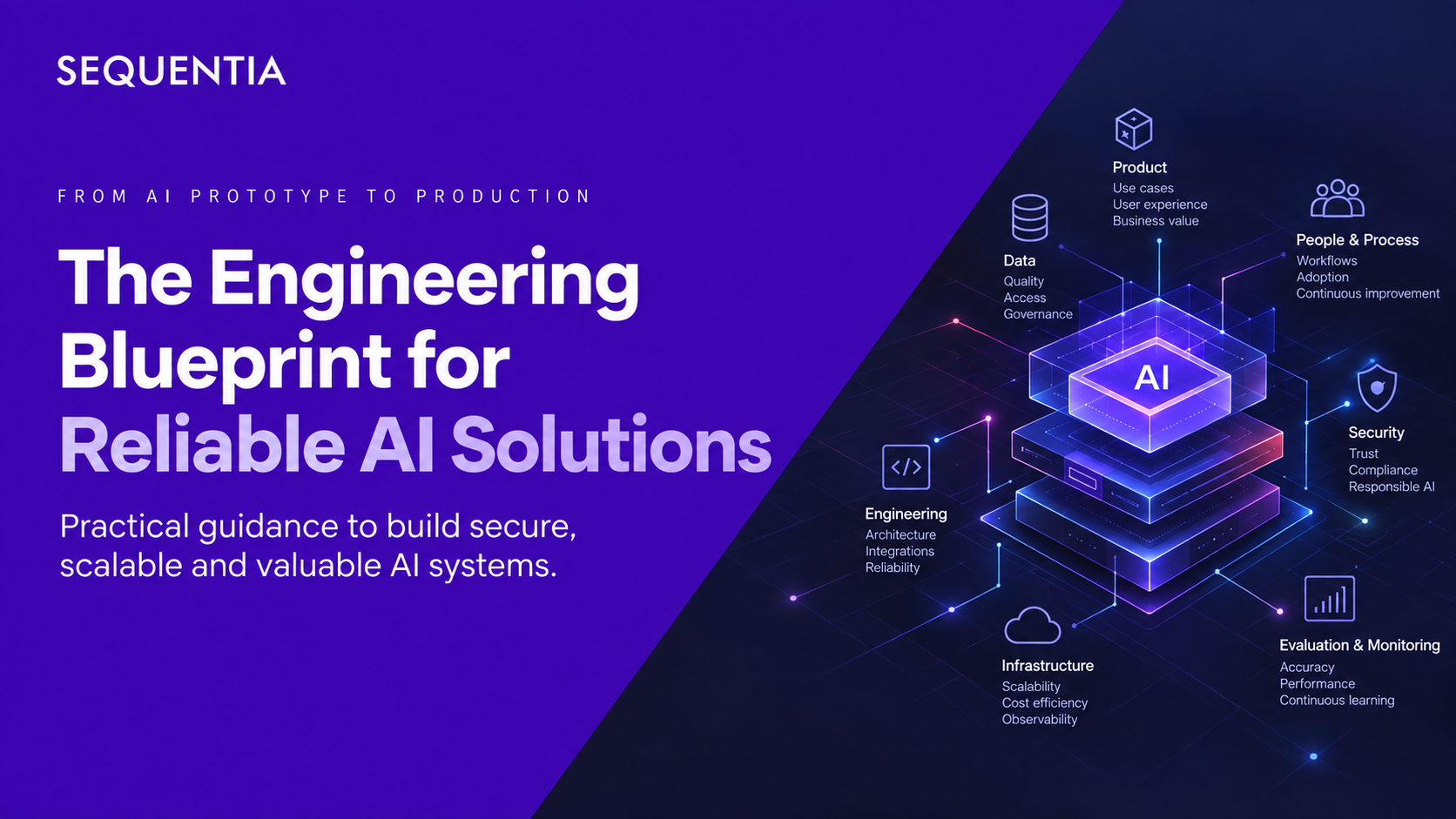
The Four Foundations of AI-Ready Architecture
Organizations that scale AI successfully aren't necessarily starting from scratch. Most are retrofitting existing infrastructure — but they're doing it systematically, and they're doing it before they need it rather than after. There are four areas where the architectural choices made early determine whether scale is achievable later.
Foundation One
Data Infrastructure That Assumes AI Access
Most enterprise data architectures were built to serve analytics — batch queries, dashboards, scheduled reports. AI workloads are different. They require low-latency retrieval, semantic search capabilities, rich metadata, and consistent data contracts that remain stable across updates. A vector database bolted next to a legacy data warehouse is not AI-ready data infrastructure. It's a pilot that happens to be in production.
The organizations getting this right are investing in unified data platforms — sometimes called lakehouse architectures — that provide a single governed layer for both analytical and AI workloads. They're building retrieval-augmented generation (RAG) pipelines not as one-off integrations but as reusable, monitored infrastructure. They're treating embeddings as first-class data artifacts with version control, refresh schedules, and quality checks.
More importantly, they're resolving the data quality problems that AI surfaces with brutal clarity. A model trained or grounded on inconsistent, incomplete, or poorly governed data will produce inconsistent, incomplete, or misleading outputs. The AI doesn't make the data problems worse — it makes them visible in a way that's impossible to ignore when the outputs are customer-facing.
Data readiness for AI is distinct from data readiness for analytics. Analytics can tolerate stale data, inconsistent schemas, and incomplete records because a human analyst applies judgment when interpreting the output. AI systems apply that judgment automatically and at scale. What looks like a minor data quality issue in a dashboard becomes a systematic error in an AI application.
Before scaling any AI workload, it's worth auditing not just data completeness but data contracts — the implicit agreements about schema, freshness, and semantics that have never been written down anywhere.
Foundation Two
Model and Inference Infrastructure
The economics of running AI models at enterprise scale are not obvious until you're already in production and someone is looking at the cloud bill. Inference costs are highly sensitive to architecture decisions — model selection, quantization, caching strategies, batching, and whether certain workloads can tolerate higher latency in exchange for lower cost.
Most organizations default to calling a frontier model API for everything. This is fine for exploration and perfectly defensible for many production workloads. But it creates a single point of dependency that becomes a strategic risk as AI becomes more central to operations. Model providers change pricing, deprecate versions, and experience outages. A mature AI-ready architecture has a model strategy, not just a model vendor.
This typically means defining a tiered approach: using large frontier models for complex reasoning tasks where quality is the primary concern, smaller fine-tuned models for high-volume, well-defined tasks where cost and latency matter most, and on-premise or private cloud deployments for workloads involving sensitive data that shouldn't leave the organization's environment. The tier boundaries aren't fixed — they evolve as model capabilities improve and costs fall — but having the infrastructure to support all three tiers is a prerequisite for sustainable scale.
Equally important is the inference layer itself. Prompt caching, request routing, rate limit management, and circuit breakers are not optional at enterprise scale. Neither is a system for tracking model versions across applications, so that when a provider updates a model, you know which of your workloads are affected before you find out from users.
Foundation Three
Observability Built for AI Behavior
Traditional application monitoring measures whether something is working. AI monitoring requires measuring whether something is working well — which is a substantially harder problem when the output is natural language or a probabilistic classification rather than an HTTP status code.
The organizations that have navigated this most effectively treat AI observability as a distinct discipline with its own tooling requirements. They instrument not just technical metrics — latency, throughput, error rates — but behavioral metrics: output quality, hallucination rates, citation accuracy, task completion rates, user correction frequency. They maintain evaluation datasets that run continuously against production traffic, not just during model updates.
This matters more than it might seem. AI systems degrade in ways that are invisible to conventional monitoring. A model might continue to return 200 OK responses while producing subtly worse outputs due to data drift, prompt injection, context window misuse, or distribution shift in user queries. Without behavioral observability, you won't know until users complain — and at enterprise scale, that's too late.
The practical implication is that scaling AI requires investing in tooling that doesn't fully exist yet. Most observability platforms are evolving to support AI workloads, but they're not there yet. Organizations that are serious about scale are building or buying specialized evaluation pipelines, maintaining ground-truth datasets with ongoing annotation programs, and treating model quality monitoring as an ongoing engineering function rather than a launch-time activity.
Foundation Four
Governance and Control Planes
Governance is where the most capable AI programs and the most cautious ones converge on the same conclusion: you need a control plane for AI workloads that sits above the individual applications. Not policies written in documents. Actual infrastructure that enforces boundaries, manages access, routes traffic, logs decisions, and provides a single point of oversight across everything the organization is running.
The need for this becomes apparent at scale in ways that are not obvious at pilot stage. When you have ten AI applications, managing each one independently is feasible. When you have a hundred — some customer-facing, some internal, some running autonomously — the combinatorial complexity of managing access controls, data permissions, model versions, and audit trails becomes unworkable without a unified layer.
A mature AI governance architecture includes centralized prompt and configuration management so that policy changes propagate automatically rather than requiring updates across dozens of applications. It includes unified audit logging that captures inputs, outputs, model versions, and timestamps in a format that satisfies both internal review processes and external regulatory requirements. And it includes human review workflows that activate intelligently — not on every output, which doesn't scale, but on outputs that fall outside expected confidence ranges or that meet criteria defined by risk teams.
The Organizational Architecture Problem
Technical architecture alone doesn't explain why some organizations scale and others don't. There's a second layer — the organizational architecture — that is, if anything, harder to get right and more determinative of outcomes.
The pattern that emerges repeatedly among successful AI scale-ups is the creation of what might be called a platform team model. Rather than having each business unit independently develop and operate its own AI capabilities, a central platform team builds and maintains the shared infrastructure — the data pipelines, model serving layer, observability tooling, governance controls — while embedded domain teams build the applications that sit on top of it. The platform team's customers are the application teams, not end users.
This model sounds bureaucratic but it's actually the opposite of how most failed scale-ups are organized, where every team independently chooses tools, maintains its own data integrations, and operates its own version of the same infrastructure. The result is a proliferation of incompatible systems, duplicated effort, and no shared understanding of what's actually running in production. The platform model concentrates the hard infrastructure problems in a team with the depth to solve them, while preserving the domain autonomy that makes AI applications actually useful.
The second organizational challenge is talent distribution. AI initiatives are often staffed with deep technical talent at the center — ML engineers, data scientists, AI researchers — and relatively little AI literacy distributed through the business. This creates a bottleneck where every AI application requires the central team's involvement, and a comprehension gap where the people closest to the business problems can't meaningfully participate in defining the AI solutions to them. Closing this gap through training, embedded roles, and accessible tooling is as important as any technical architecture decision.
What "AI-Ready" Actually Means in Practice
The term AI-ready has become so overloaded that it risks meaning nothing. Vendors apply it to products. Consultants apply it to assessments. Executives apply it to strategies. It's worth being specific about what a genuinely AI-ready enterprise architecture looks like when you're actually operating one.
It means a new AI application can be deployed to production in weeks, not quarters, because the shared infrastructure already exists and the deployment process is standardized. It means that when a model provider releases a significant update, the organization can evaluate its impact across all running workloads before updating, not after. It means that when a regulator asks what data an AI system accessed to produce a particular output, the answer is available in an audit log rather than reconstructed from memory. It means that a data quality problem identified in one AI application can be fixed once at the data layer rather than independently patched in each application that shares the same source.
Most importantly, it means the organization has genuine visibility into what its AI systems are doing and genuine control over how they behave. Not in a theoretical, policy-document sense, but in an operational sense where the tools exist to detect problems, understand their source, and address them with confidence.
A useful diagnostic for AI readiness is to ask what happens when something goes wrong. If the answer involves manual log searches, Slack messages to the people who built the system, and a several-day investigation before root cause is established — the infrastructure is pilot-grade, not production-grade. AI-ready infrastructure treats incidents the same way any well-operated production system does: with runbooks, dashboards, automated alerting, and a clear escalation path.
The Right Sequence
None of this means organizations should wait for perfect infrastructure before scaling AI. Waiting for perfect infrastructure is itself a way of not scaling. But it does suggest a different sequencing than most organizations follow.
The most effective approach is to treat the first real production deployment — not the pilot, but the first thing that genuinely matters to the business — as an opportunity to build shared infrastructure rather than a one-off solution. The extra investment required to build reusable pipelines, shared observability, and governed access controls on the first deployment pays for itself many times over on the second, third, and tenth deployments. Organizations that instead optimize each deployment for speed accumulate technical debt that eventually stops them cold.
The second sequencing insight is that data infrastructure needs to lead model deployment, not follow it. The most common failure mode in AI scale-up is discovering data quality problems after the model is in production and users are depending on it. Resolving those problems retroactively is far more expensive and disruptive than resolving them before the model ever sees the data. A six-week investment in data quality and governance before deployment almost always pays for itself in avoided production incidents.
The third is that governance infrastructure should be built for the scale you're planning to reach, not the scale you're currently at. Adding governance controls to a hundred AI applications that were built without them is a multi-year remediation project. Building them into the platform from the start costs a fraction of that and removes the existential risk of a significant AI incident occurring before controls are in place.
The Organizations That Get This Right
The enterprises successfully scaling AI share something that's easy to overlook when discussing technology: they've made a genuine organizational commitment to AI as infrastructure rather than AI as a series of projects. Projects have sponsors, timelines, and success criteria. Infrastructure has owners, SLAs, and a mandate to keep running. The shift in mindset — treating AI capability as something the organization operates and maintains, like its databases and networks and identity systems — is what makes the technical architecture investments worthwhile.
The pilot-to-production gap that stops so many AI initiatives is real, but it's not inevitable. It's the predictable result of building for the experiment rather than building for the operation. Organizations willing to invest in the infrastructure layer — data, models, observability, governance — before the pressure to scale becomes urgent are the ones whose AI investments compound over time rather than accumulating as a collection of impressive demonstrations that never quite changed anything.
The models will keep improving. The infrastructure that determines whether those improvements reach the people and workflows that could benefit from them — that's what's worth building now.
Pune
Sequentia Software Solutions Pvt Ltd
401, Koyna, Mohan Nagar,
Baner, Pune, Maharashtra - 411045.
Jalgaon
Sequentia Software Solutions Pvt Ltd
06, Rambhau Joshi Market, Opposite Golani Market, Navi Peth, Jalgaon, Maharashtra - 425001.