Product Engineering at Scale: Designing Systems That Support AI, Automation, and Growth
As enterprises grow, product engineering becomes less about building features and more about sustaining change. What once worked for a small team or a single product line begins to strain under increased scale, complexity, and expectation. Delivery slows. Quality becomes uneven. Teams struggle to align. Systems resist change.
The introduction of AI and automation accelerates this challenge. These technologies increase both opportunity and pressure. They demand cleaner data, clearer ownership, stronger architecture, and greater operational discipline. In many organizations, they expose weaknesses that were previously manageable.
Scaling product engineering in this environment requires more than additional resources or better tools. It requires deliberate system design, organizational alignment, and a shift in how engineering success is defined.
At Sequentia, we see product engineering at scale as a strategic capability. It determines whether enterprises can grow confidently or whether complexity eventually limits progress.
Why Product Engineering Breaks Down at Scale
Early in a product’s life, engineering teams benefit from proximity and informality. Decisions happen quickly. Context is shared. Ownership is implicit. Architecture evolves organically.
As products scale, this informality becomes a liability.
Teams multiply. Responsibilities overlap. Decisions require coordination. Dependencies increase. What was once intuitive becomes opaque. Without deliberate structure, engineering slows despite increased effort.
AI and automation amplify this effect. They introduce new dependencies on data pipelines, model behavior, monitoring, and compliance. Systems that lack clear boundaries struggle to absorb this complexity.
Scaling engineering successfully requires acknowledging that growth changes the nature of work.
Scale Demands a Shift From Projects to Platforms
One of the most important transitions enterprises must make is moving from project thinking to platform thinking.
Projects focus on delivery. Platforms focus on enablement.
When engineering operates in project mode, success is measured by completion. Features are delivered, systems go live, and teams move on. Over time, this creates fragmented solutions and inconsistent practices.
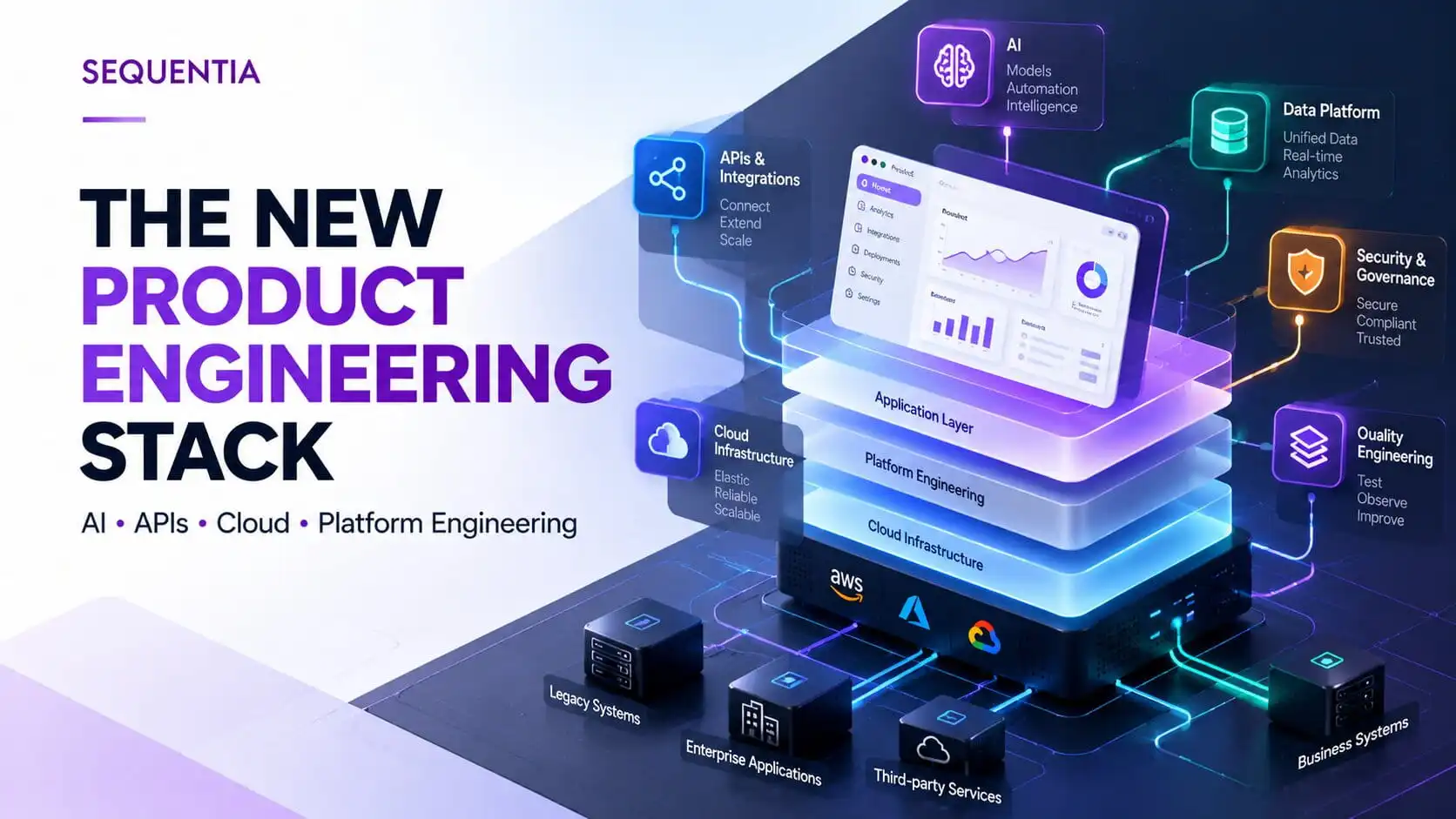
Platform thinking emphasizes reuse, consistency, and long-term evolution. Shared capabilities are treated as products. Interfaces are stable. Quality is embedded. Teams build on top of existing foundations rather than reinventing them.
AI and automation depend heavily on platform capabilities. Data access, model deployment, observability, and integration must be reliable and reusable. Without platform thinking, these capabilities are duplicated inconsistently, increasing risk and cost.
Architecture as the Backbone of Scalable Engineering
Architecture is often discussed as a technical concern, but at scale it becomes an operational one.
Well-designed architecture reduces cognitive load. It allows teams to reason about systems independently. It limits the impact of change. It enables parallel work without constant coordination.
Poor architecture does the opposite. Every change requires negotiation. Testing expands. Delivery slows. Teams become cautious.
AI-driven systems heighten the importance of architecture. Model behavior must be isolated. Data flows must be controlled. Failure modes must be predictable.
Enterprises that invest in modular, capability-aligned architecture create an environment where engineering can scale sustainably.
APIs as Enablers of Independent Teams
As engineering organizations grow, independence becomes essential.
APIs enable this independence by defining clear contracts between systems and teams. They allow internal implementations to change without affecting consumers. They reduce coordination overhead and make dependencies explicit.
In scalable engineering organizations, APIs are treated as products. They are designed thoughtfully, documented clearly, and governed consistently.
When APIs are rushed or inconsistent, scale becomes painful. Teams must coordinate constantly. Integration issues surface late. Trust erodes.
AI and automation increase the number of integrations and interactions. Without disciplined API practices, complexity quickly overwhelms teams.
Data Architecture Determines AI Readiness
AI cannot compensate for poor data foundations.
At scale, data architecture determines whether AI initiatives succeed or stall. Shared databases, unclear ownership, and inconsistent data quality create friction that grows with every new use case.
Scalable product engineering requires domain-aligned data ownership. Each capability should own its data and expose it through controlled interfaces. This approach enables analytics, automation, and AI while maintaining governance.
Organizations that ignore data architecture often find themselves investing heavily in AI tooling without seeing proportional value.
Quality Engineering Becomes a Force Multiplier
At small scale, quality issues can be addressed reactively. Teams rely on experience and manual checks. This approach does not survive growth.
As engineering scales, quality must become systematic.
Automated testing, monitoring, observability, and resilience validation provide feedback that allows teams to move confidently. Without these signals, fear replaces trust. Releases slow. Innovation stalls.
AI systems intensify the need for quality engineering. Model drift, data anomalies, and unexpected behavior must be detected early. Without strong quality practices, AI increases operational risk.
Quality engineering is not overhead. It is an enabler of scale.
Organizational Design Shapes Engineering Outcomes
Engineering systems reflect organizational structure.
When teams are aligned to capabilities, systems evolve coherently. When teams are organized around projects or technologies, fragmentation increases.
At scale, organizational design becomes a strategic decision. It determines how ownership is distributed, how decisions are made, and how accountability is enforced.
AI and automation introduce cross-cutting concerns that challenge traditional silos. Data, models, and platforms span multiple teams. Without clear ownership and collaboration models, execution slows.
Enterprises that redesign organizational structures alongside systems scale more effectively.
Managing Growth Without Losing Speed
A common fear among leaders is that structure slows innovation.
In reality, the absence of structure slows growth more severely.
Clear boundaries, ownership, and standards reduce coordination overhead. They allow teams to work independently without constant negotiation. They enable faster decision-making as scale increases.
Scalable engineering is not about adding process. It is about reducing friction.
AI-driven growth magnifies the cost of friction. Enterprises that address it early gain a significant advantage.
The Role of Leadership in Scaling Engineering
Scaling product engineering is not a problem engineering teams can solve alone.
Leadership decisions shape priorities, incentives, and investment. When leaders prioritize short-term delivery over foundational health, engineering suffers. When they invest in platforms, quality, and clarity, engineering scales.
AI increases the strategic importance of these decisions. Leaders must engage with engineering realities, not just outcomes.
Product engineering at scale is a leadership responsibility.
How Sequentia Supports Scalable Product Engineering
At Sequentia, we help enterprises design product engineering capabilities that scale with growth.
Our approach combines architecture design, API strategy, data governance, quality engineering, and organizational alignment. We focus on building systems and teams that can evolve together.
We do not optimize for short-term velocity. We optimize for sustained adaptability.
Enterprises that scale engineering successfully do not chase every trend. They invest in foundations that support whatever comes next.
Scale Changes Everything
Product engineering at scale is fundamentally different from product engineering at startup size.
AI and automation amplify this difference. They reward clarity, discipline, and strong foundations. They punish fragmentation and shortcuts.
Enterprises that recognize this early design systems and organizations that grow together. Those that do not find complexity growing faster than capability.
Scale is not the problem.
Lack of preparation is.

.webp)
Pune
Sequentia Software Solutions Pvt Ltd
401, Koyna, Mohan Nagar,
Baner, Pune, Maharashtra - 411045.
Jalgaon
Sequentia Software Solutions Pvt Ltd
06, Rambhau Joshi Market, Opposite Golani Market, Navi Peth, Jalgaon, Maharashtra - 425001.