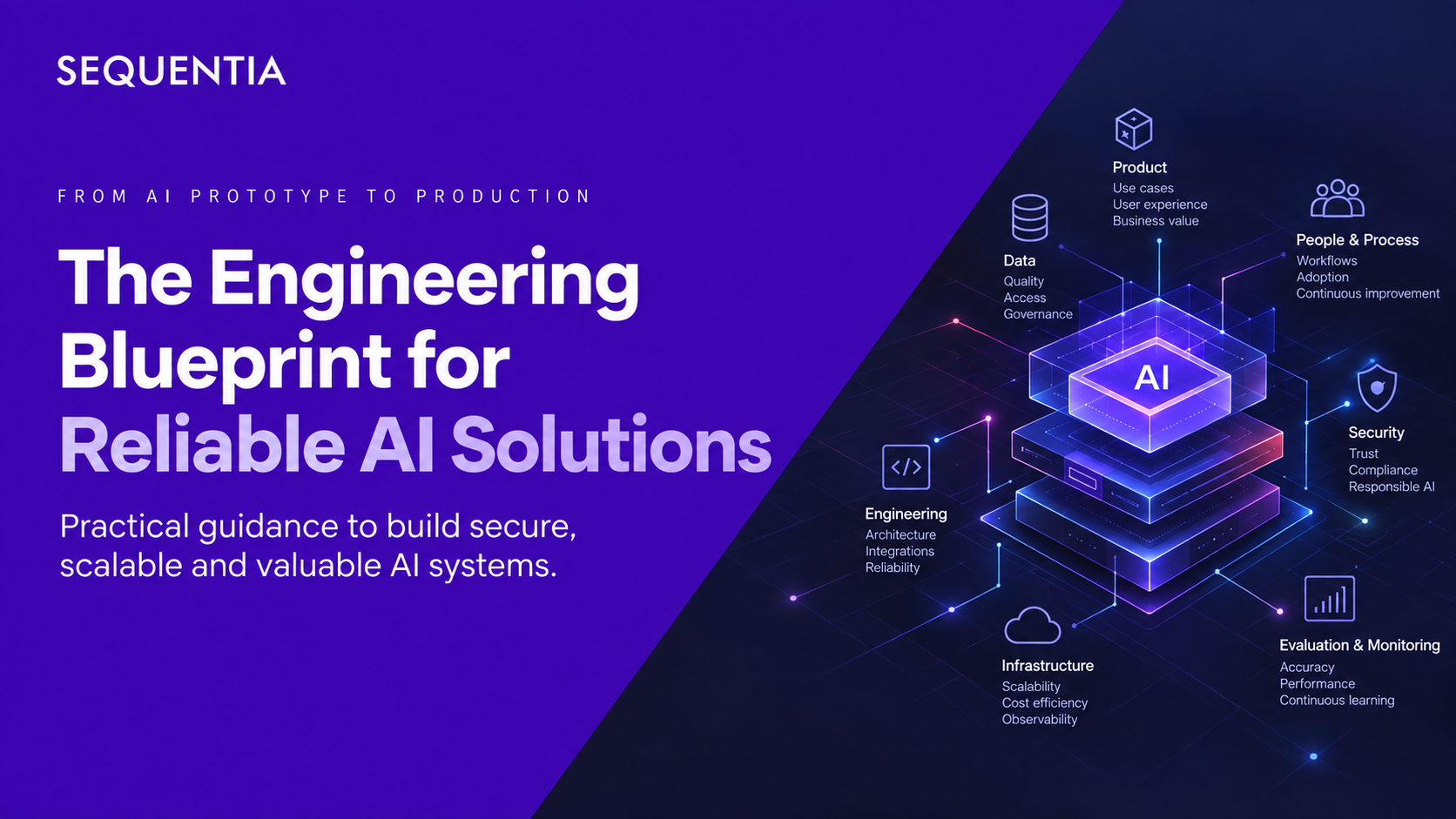
From AI Prototype to Production: The Engineering Blueprint for Reliable AI Solutions
Building an AI prototype has never been easier.
A team can connect an AI model to an application, provide it with relevant information, build a simple interface, and demonstrate an impressive result in a relatively short time.
That speed is one of the most exciting things about modern AI.
But there is a significant difference between an AI solution that works in a demonstration and an AI system that can reliably operate in production.
Once real users, real data, real workloads and real business expectations enter the picture, the engineering challenge changes considerably.
The question is no longer simply, “Can we make AI do this?”
It becomes:
Can we make it reliable, secure, scalable, measurable and economically sustainable?
That is where AI engineering becomes critical.
The production gap is bigger than most prototypes reveal
A prototype is designed to answer one important question:
Is this idea technically possible?
A production system has to answer many more.
Can users depend on it? Can the system handle unexpected inputs? Can the team identify when the AI produces a poor response? Can sensitive information be protected? Can the architecture handle increased traffic? Can the business predict the operating cost?
These requirements don't necessarily make the AI model itself more complicated.
They make the system around the model more sophisticated.
This is why moving from prototype to production should not be treated as simply adding more infrastructure to an existing proof of concept. It often requires revisiting the architecture, data flow, integrations, security model, evaluation process and operational design.
1. Start with the workflow, not the model
One of the first architectural decisions should actually happen before selecting a model.
Understand the workflow.
Where does the process begin? What information enters the system? What decisions need to be made? Which steps currently require human intervention? What systems are involved? What happens when the expected information isn't available?
This helps determine where AI genuinely belongs.
For example, an AI model may be excellent at extracting information from documents, but that doesn't mean the entire document-processing workflow should be handed to an AI system.
A better architecture might use AI for extraction, deterministic software for validation, business rules for decisions, and human review for exceptions.
The goal isn't to make everything intelligent. The goal is to make the overall workflow better.
2. Treat data as part of the architecture
AI applications frequently depend on information coming from multiple sources.
Databases, documents, APIs, internal applications, customer records and third-party systems may all contribute context to the final response.
That makes data architecture a core part of the AI solution.
Before moving to production, teams need to understand where the data comes from, how current it is, who can access it, how it is transformed, and how its quality is validated.
A sophisticated model working with incomplete or unreliable information can still produce an unreliable outcome.
This is particularly important for applications using retrieval-augmented generation or other knowledge-retrieval approaches. The retrieval layer, document processing, indexing, permissions and source management all influence the quality of the final response.
The model is only one component in that chain.
3. Design the application around the model
An AI model should rarely be treated as the application itself.
It is one component within an application architecture.
The surrounding system may include an API layer, authentication, business logic, databases, queues, caching, external integrations, observability tools and user interfaces.
That architecture needs to determine what the model should and should not be responsible for.
For example, business-critical calculations may be better handled through deterministic application logic rather than relying on an AI-generated answer.
Similarly, access permissions should not depend on the model deciding whether a user is allowed to see particular information.
AI can generate or interpret information. The application still needs to enforce the rules.
This distinction becomes particularly important as AI applications become more autonomous.
4. Build evaluation into the product
Traditional software testing often has relatively deterministic expectations.
If a calculation receives certain inputs, the expected output can usually be defined precisely.
AI systems introduce another layer of complexity.
The same prompt may produce different responses. A response can be grammatically correct but factually wrong. It can contain useful information while missing an important requirement.
That means AI systems need deliberate evaluation.
Teams should define what a good response looks like before deploying the system.
Depending on the use case, this could include accuracy, relevance, completeness, groundedness, response time, refusal behavior or adherence to business rules.
Evaluation should not be something that happens only during the initial prototype.
It needs to become part of the development and operational lifecycle.
5. Plan for failure, not just successful responses
A production AI system needs to know what happens when the AI doesn't know the answer.
That sounds obvious, but it is one of the most important design considerations.
The system may encounter incomplete information, ambiguous requests, unsupported questions, unavailable services or responses that don't meet the required quality threshold.
There should be defined behavior for these situations.
Sometimes the correct response is to ask the user for more information.
Sometimes it is to fall back to deterministic logic.
Sometimes it is to route the case to a human.
And sometimes the safest answer is simply not to provide an answer.
Reliability isn't about making AI correct all the time. It's about designing the system to behave appropriately when AI is uncertain or wrong.
6. Security needs to exist at every layer
AI introduces additional security considerations, but security should not be treated as an AI-only problem.
A production architecture still needs conventional application security:
Authentication, authorization, encryption, secure APIs, secrets management, logging and access controls.
On top of that, AI applications introduce additional concerns.
What information is being sent to the model? Where is that information processed? Can a user manipulate the system into revealing information they shouldn't have access to? Can external content influence the model's behavior? What happens to sensitive data within third-party services?
These questions need to be addressed during architecture and design, not after deployment.
Security becomes much harder to retrofit once an AI application is already deeply integrated into business workflows.
7. Infrastructure determines whether the solution can scale
A successful prototype may have very different infrastructure requirements from a production application.
Latency becomes important.
Concurrency becomes important.
Availability becomes important.
So does cost.
A production AI architecture may need appropriate compute resources, caching strategies, asynchronous processing, queues, load management, monitoring and failure recovery.
The infrastructure decision also needs to account for how the AI service is being consumed.
Is the application calling an external model API? Is a model being hosted internally? Are different models being used for different tasks? Can expensive model calls be reduced through caching or simpler processing?
These decisions can have a significant impact on operating costs.
Scaling an AI application isn't just about handling more users. It's also about controlling the cost and complexity of serving those users.
8. Don't underestimate third-party dependencies
Modern AI applications often depend on multiple external services.
Model providers, vector databases, cloud platforms, APIs, document-processing services and other infrastructure components can become part of the application's critical path.
That creates dependency risk.
What happens if a service is temporarily unavailable?
What happens if an API changes?
What happens if pricing changes?
What happens if the model version changes and response behavior changes with it?
Production architecture should make these dependencies visible and, where appropriate, provide fallback or migration strategies.
The objective isn't to eliminate dependencies.
It is to understand and control them.
9. Observability becomes essential after launch
Once an AI system is live, the team needs visibility into what is actually happening.
How many requests are being processed?
How long are responses taking?
Which workflows are failing?
Which types of questions produce poor results?
How much are model calls costing?
Are users abandoning particular workflows?
Are error rates increasing?
Without adequate observability, teams are effectively operating the system with limited visibility.
And AI systems can change behavior in ways that traditional application monitoring doesn't always capture.
Operational monitoring therefore needs to consider both traditional system metrics and AI-specific quality indicators.
10. AI architecture should evolve with the business
Another mistake is treating the first production architecture as permanent.
AI technology is changing rapidly.
Models improve. Costs change. new capabilities become available. Better tools emerge.
The architecture should therefore allow appropriate components to evolve without requiring the entire application to be rebuilt.
This is one reason abstraction and modularity matter.
The business should ideally be able to change a model, retrieval strategy or supporting service without rewriting every part of the product.
The goal is not to predict which AI technology will dominate several years from now.
The goal is to build a system that can adapt as the technology changes.

A practical production-readiness checklist
Before moving an AI solution from prototype to production, it is worth asking:
Product
Is the business problem clearly defined?
Is the AI actually improving the workflow?
Are success metrics measurable?
Data
Are the required data sources available?
Is the data reliable and current?
Are access permissions enforced?
Application
Is the AI component properly separated from business-critical rules?
Are integrations reliable?
Are failure and fallback paths defined?
AI evaluation
Do we know what a good response looks like?
Are responses being evaluated consistently?
Are important failure cases covered?
Security
Is sensitive information protected?
Are authentication and authorization handled outside the model?
Are AI-specific attack scenarios considered?
Infrastructure
Can the system handle expected workloads?
Is latency acceptable?
Are costs understood?
Is monitoring in place?
Operations
Can the team identify failures quickly?
Can model or dependency changes be managed?
Is there a process for continuous evaluation and improvement?
If several of these questions don't have clear answers, the solution may still be a prototype—even if users can already interact with it.
The real objective isn't “production AI”
There is sometimes a tendency to treat production deployment as the finish line.
It isn't.
Production is where the real feedback begins.
Once users interact with the system, teams learn which responses are useful, where workflows break down, which data is missing, which integrations create friction and where the economics work—or don't.
That information should feed the next iteration.
The strongest AI applications will therefore not be the ones that simply make it into production.
They will be the ones that are designed to learn and improve after production.
From AI experiment to dependable product
AI has dramatically reduced the time required to experiment with new product ideas.
That is a significant advantage.
But speed of experimentation shouldn't be confused with speed of production readiness.
The engineering discipline required to build dependable software still matters.
In fact, as AI becomes more deeply integrated into products and business processes, it matters even more.
A successful AI solution needs more than a capable model.
It needs a clear product problem, reliable data, thoughtful architecture, appropriate infrastructure, strong security, continuous evaluation and an operational model that can evolve.
The prototype proves that the idea can work.
The engineering makes it something the business can depend on.
Pune
Sequentia Software Solutions Pvt Ltd
401, Koyna, Mohan Nagar,
Baner, Pune, Maharashtra - 411045.
Jalgaon
Sequentia Software Solutions Pvt Ltd
06, Rambhau Joshi Market, Opposite Golani Market, Navi Peth, Jalgaon, Maharashtra - 425001.