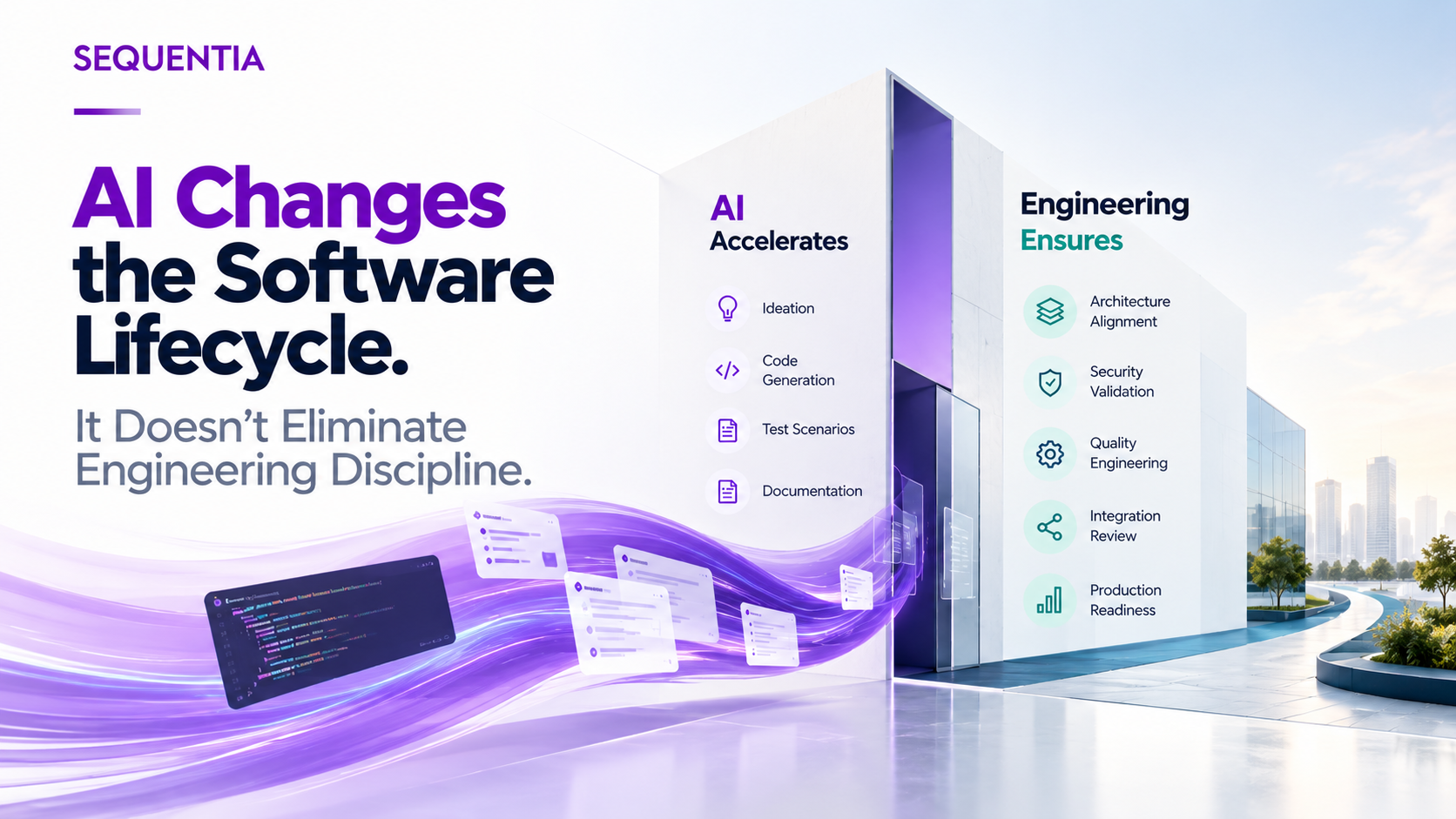
AI Changes the Software Lifecycle. It Doesn't Eliminate Engineering Discipline.
AI is changing how software teams approach implementation, testing, documentation and problem-solving. Tasks that once required substantial manual effort can now be accelerated with AI-assisted development tools. Engineers can explore alternatives faster, generate initial implementations, create test scenarios and investigate unfamiliar codebases with greater efficiency.
However, the ability to produce code faster does not automatically improve the quality of the software being delivered. Enterprise applications still operate within complex environments involving business rules, integrations, security requirements, data dependencies and operational constraints. In these environments, the quality of the engineering process remains as important as the speed of implementation.
The real opportunity is not to replace established engineering practices with AI. It is to redesign parts of the software lifecycle so that AI contributes to faster delivery while architecture, validation and accountability remain intact.
Faster Implementation Does Not Guarantee Better Software
AI-generated code can be useful for accelerating routine implementation, exploring technical approaches and reducing repetitive work. Yet generated code is still an implementation that needs to be evaluated against the product's actual requirements.
A function may produce the expected result for a simple example while failing under unusual input conditions. A suggested change may solve a local problem but introduce a dependency that affects other modules. An implementation may follow a familiar pattern without accounting for the application's authorization model, performance requirements or established conventions.
These issues become more significant when code is integrated into an existing enterprise product.
The relevant question is therefore not simply how much code AI can generate. It is how effectively the team can establish correctness, maintainability and compatibility before that code reaches production.
Product Engineering needs to measure progress through working, validated product capabilities rather than the volume of generated output.
Architecture Becomes More Important as Code Generation Accelerates
When implementation becomes faster, architecture can become a critical constraint. Teams may generate changes more quickly than they can evaluate their impact, particularly when the application contains tightly coupled components or poorly documented dependencies.
Clear module boundaries, explicit interfaces and well-defined business responsibilities help limit this risk. They make it easier to understand where a change belongs, what it may affect and how its behaviour should be validated.
API Driven Development plays an important role where applications and services need to communicate through stable contracts. AI-assisted tools can help create implementations and supporting tests, but engineers still need to ensure that these interfaces preserve compatibility, security and expected behaviour.
Architecture also provides context for AI-assisted development. Without clear standards and an understanding of the system, generated solutions may introduce inconsistent patterns that increase maintenance effort over time.
The objective is to make implementation more efficient without allowing architectural complexity to grow faster than the team's ability to manage it.
Quality Engineering Must Move With AI-Assisted Development
Traditional testing approaches can become a bottleneck when code changes are produced more frequently. If validation remains largely manual or happens only near release time, faster implementation may simply create a larger queue of unverified changes.
Quality Engineering needs to evolve alongside the development process.
AI can assist with generating test cases, identifying potential edge conditions, suggesting regression scenarios and analysing failures. These capabilities can expand test coverage and help teams investigate defects more efficiently. However, generated tests are not automatically comprehensive or correct. They can repeat the assumptions present in the implementation or overlook important business conditions.
Engineering teams still need to define expected behaviour, identify critical workflows and determine which failures carry the greatest business risk. Automated tests should validate business rules, integration contracts, permissions, error handling and relevant performance expectations.
Independent review is especially important for critical functionality. A test that merely confirms that generated code behaves as the code expects may not establish that the implementation meets the actual requirement.
The aim is to combine AI-assisted testing with clear acceptance criteria, meaningful coverage and reliable release controls.
Security and Governance Cannot Be Delegated to Generated Output
Enterprise software operates under security, privacy and compliance requirements that cannot be satisfied simply because an implementation appears correct.
AI-assisted development can introduce insecure dependency choices, insufficient input validation, exposed secrets or incorrect authorization checks. It may also suggest changes that conflict with the application's security architecture.
Security review should therefore remain integrated into development. Dependency analysis, static analysis, secret detection, access-control validation and appropriate security testing can help identify risks before deployment. Human review remains important when changes affect sensitive data, privileged operations or critical business workflows.
Organizations also need clear policies governing the use of AI development tools, including the handling of confidential code, customer information and proprietary data.
These controls should be proportionate to the system's risk. The goal is not to add unnecessary approval steps to every change, but to ensure that faster implementation does not bypass essential safeguards.
Rethinking the Engineering Workflow
The strongest results are likely to come from redesigning selected parts of the lifecycle rather than introducing AI tools without changing how teams work.
For example, AI may help engineers understand an unfamiliar module before making a change. It may assist with generating an initial implementation, while code review and automated tests validate the result. During defect investigation, it may help correlate logs or propose possible causes, while engineers verify the diagnosis against production evidence.
This approach connects AI assistance to defined engineering responsibilities.
Product Design & Engineering can use AI to accelerate exploration and implementation while retaining alignment between customer needs, product decisions and technical execution. Quality Engineering can strengthen continuous validation. Infrastructure Managed Services can support the monitoring, deployment and operational practices required to run software reliably after release.
Application Transformation also benefits from this discipline. AI may help teams analyse legacy code, document dependencies or accelerate selected modernization tasks, but generated changes still need to respect the existing system's business behaviour and integration constraints.
The workflow should make it clear which tasks AI assists with, what evidence is required for acceptance, and who remains accountable for the final outcome.
Measure Engineering Outcomes, Not AI Activity
The presence of AI in a development workflow is not itself a meaningful measure of success. Counting generated lines of code or the number of AI-assisted tasks can create the appearance of progress without demonstrating better delivery.
More useful measures include lead time for validated changes, escaped defects, change failure rate, review effort, test effectiveness, maintainability and the time required to restore service after a failure. Teams should also examine whether AI-assisted work creates additional review or rework that offsets its initial speed advantage.
The appropriate measures depend on the product and delivery environment. A regulated application, a customer-facing platform and an internal business tool will have different risk profiles.
What matters is establishing a baseline and evaluating whether AI improves the full engineering outcome, not just one stage of implementation.
Engineering Discipline Is the Advantage
AI is changing the economics and mechanics of software development. Teams can explore ideas faster, automate repetitive work and increase the amount of implementation they can accomplish within a given period.
But reliable software still depends on understanding requirements, making sound architectural decisions, validating behaviour, protecting data and managing operational risk.
Organizations that treat AI as a substitute for engineering discipline may accelerate the production of complexity. Organizations that integrate AI into a controlled engineering lifecycle can improve efficiency while preserving confidence in the products they deliver.
The future of Product Engineering will not be defined solely by how quickly software can be generated. It will be defined by how effectively teams turn that output into secure, maintainable and dependable digital products.


Pune
Sequentia Software Solutions Pvt Ltd
401, Koyna, Mohan Nagar,
Baner, Pune, Maharashtra - 411045.
Jalgaon
Sequentia Software Solutions Pvt Ltd
06, Rambhau Joshi Market, Opposite Golani Market, Navi Peth, Jalgaon, Maharashtra - 425001.