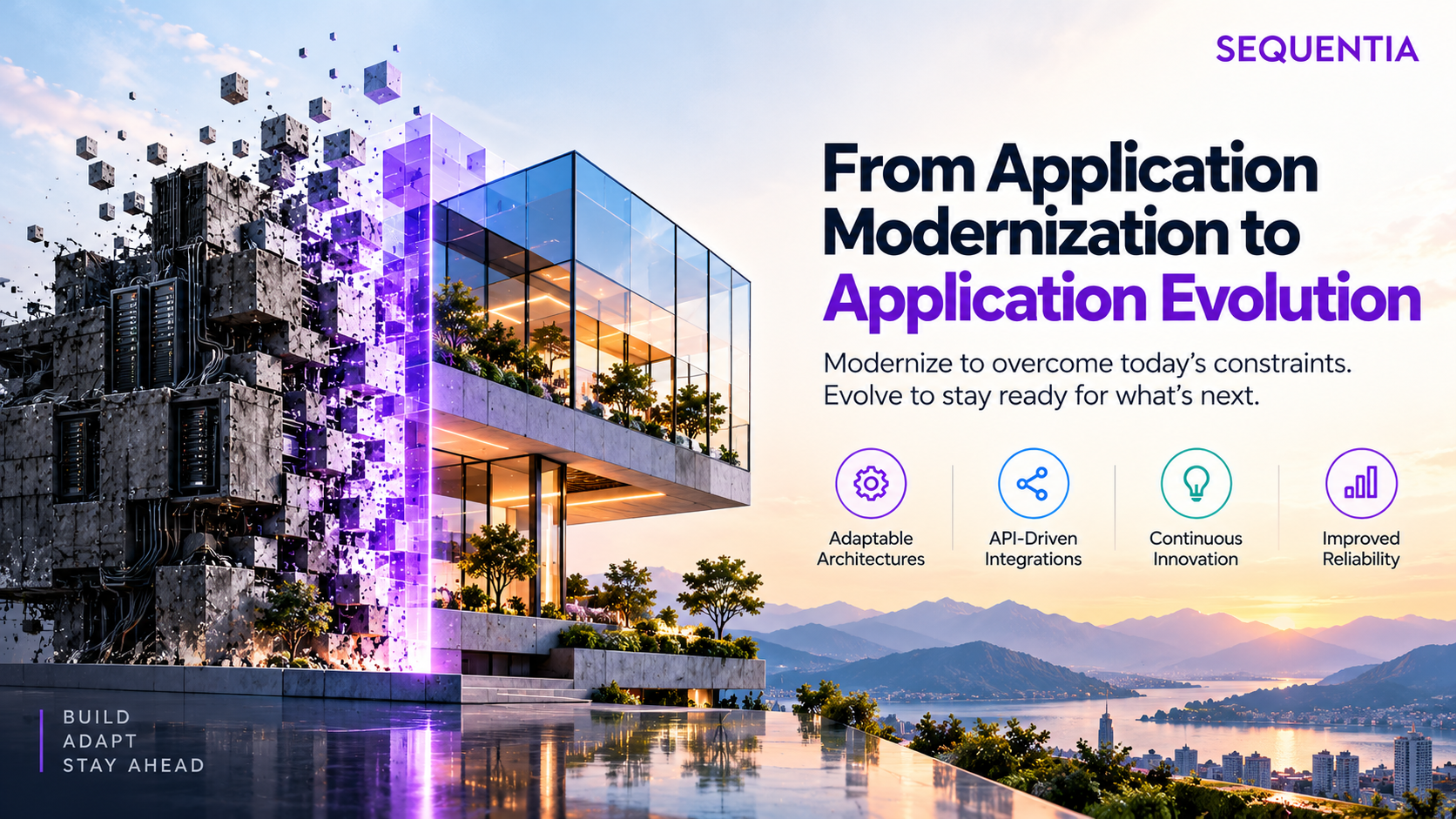
From Application Modernization to Application Evolution
Application modernization has become an important priority for organizations managing complex technology environments. Legacy applications can create limitations around performance, integration, security, scalability and the speed at which new business capabilities can be delivered. Modernizing these systems helps address immediate constraints and creates opportunities to improve the technology foundation.
However, modernization alone does not guarantee long-term adaptability.
An application can move to a modern infrastructure, adopt a newer framework and receive an updated interface, yet still retain architectural dependencies that make future changes difficult. As business requirements continue to evolve, organizations need an approach that goes beyond replacing older technology.
The next stage is application evolution: building the capability to continuously adapt, improve and extend enterprise applications as business and technology requirements change.
Why Modernization Cannot Be a One-Time Initiative
Traditional modernization initiatives are often organized around a defined scope. An application is assessed, a target architecture is selected, migration or redevelopment takes place, and the project is considered complete once the new environment is operational.
This approach can deliver substantial value. It can reduce infrastructure costs, improve maintainability, address security limitations and provide access to modern development capabilities.
The challenge is that the operating environment continues to change after the project ends.
New integrations may be required. Business processes may need to be redesigned. Customer expectations may introduce new product capabilities. Data volumes and usage patterns may change. Technology platforms and security requirements will continue to evolve.
If the modernized application cannot accommodate these changes efficiently, another modernization exercise may become necessary.
The objective should therefore be to establish an application environment that supports ongoing change, rather than simply delivering a newer version of the existing system.
Modernization Needs to Address Architectural Constraints
Replacing outdated technology without addressing underlying architecture can preserve many of the problems that made modernization necessary.
Tightly coupled modules, duplicated business logic, unclear data ownership and direct dependencies between applications can continue to restrict flexibility. Even when individual components use modern technologies, these structural issues can make changes expensive and risky.
Application Transformation should begin with an understanding of how the application actually operates. This includes its business capabilities, integration dependencies, data flows, performance characteristics and operational requirements.
In some cases, modularizing a specific capability may be sufficient. In others, introducing clear API boundaries or separating responsibilities between services may provide a better path forward.
Product Tech Advisory helps organizations evaluate these options against business priorities, technical constraints and the long-term cost of maintaining the application landscape.
The aim is not to introduce architectural complexity for its own sake. It is to remove constraints that prevent the business from moving forward.
Build for Continuous Integration and Change
Enterprise applications rarely operate independently. They exchange information with ERP platforms, CRM systems, payment services, data platforms, partner systems and customer-facing digital products.
As this ecosystem expands, integration design becomes central to application evolution.
API Driven Development can help establish consistent interfaces between systems, making it easier to introduce new consumers and evolve individual capabilities without requiring extensive changes across the entire environment.
Clear interface contracts, version management, access controls and observability help make these relationships more predictable. They also reduce the risk of creating another layer of tightly coupled dependencies.
Integration architecture should be considered alongside application architecture. A system that is internally modular but difficult to connect with the wider enterprise environment may still become a constraint on digital product development.
Quality Engineering Makes Evolution Sustainable
Continuous change creates a responsibility to protect existing functionality.
As applications grow, even small modifications can affect workflows, integrations and business rules that are not immediately visible to the development team. Without reliable validation, the risk of introducing regressions increases.
Quality Engineering needs to be embedded throughout the application lifecycle. Automated regression testing, integration testing, security validation and performance testing help teams evaluate changes before they reach production.
Observability provides another important feedback mechanism. Monitoring application behaviour, tracking dependencies and analysing operational issues help teams identify where the architecture needs attention.
These practices make application evolution more controlled. Teams can introduce improvements more frequently while maintaining confidence in the reliability of existing capabilities.
Cloud and Infrastructure Should Support Business Flexibility
Infrastructure modernization is often a major part of application transformation, but cloud adoption should not be treated as the final measure of success.
The infrastructure needs to support the application's actual operating requirements. Scalability, availability, security, performance, cost management and deployment flexibility all influence the long-term effectiveness of the environment.
Infrastructure Managed Services can help maintain operational reliability while providing the monitoring, maintenance and infrastructure management needed for applications that continue to evolve.
The important consideration is alignment. Infrastructure decisions should support application architecture and business demand, rather than introducing technology changes that have little practical impact on the product or organization.
Modernize According to Business Priorities
Not every application requires the same modernization approach. Some systems are business-critical and need careful incremental transformation. Others may be suitable for redevelopment, consolidation or retirement.
A practical modernization strategy considers business value, technical risk, operational dependencies and the cost of delaying change.
For example, an application that supports an essential business process may benefit from gradual separation of its modules, while a customer-facing platform with rapidly changing requirements may need a broader architectural redesign.
The sequence of modernization also matters. Organizations should prioritize changes that remove significant constraints, reduce operational risk or enable important business capabilities.
This avoids turning modernization into a technology exercise disconnected from measurable outcomes.
Creating an Application Environment That Can Evolve
Moving from application modernization to application evolution requires a broader engineering mindset.
Architecture must be reviewed as the application grows. Integrations need clear ownership. Quality validation must remain continuous. Infrastructure must support changing workloads, and technical debt needs to be managed before it becomes a major obstacle.
Product Engineering, Application Transformation and Enterprise Modernization need to work together to establish these capabilities.
The result is not an application that never needs modernization again. Technology will continue to change, and some components will eventually need replacement. The difference is that the organization has a more deliberate way to identify, prioritize and implement those changes.
Modernization changes the application landscape. Application evolution changes how effectively an organization can keep that landscape relevant.
Pune
Sequentia Software Solutions Pvt Ltd
401, Koyna, Mohan Nagar,
Baner, Pune, Maharashtra - 411045.
Jalgaon
Sequentia Software Solutions Pvt Ltd
06, Rambhau Joshi Market, Opposite Golani Market, Navi Peth, Jalgaon, Maharashtra - 425001.