From AI Models to Enterprise AI Engineering: Building the Stack Behind Intelligent Applications
Artificial intelligence is becoming part of mainstream enterprise technology, but the architecture required to support it is becoming more complex.
An AI-powered application may appear simple from the outside. A user submits a request, the system processes information and an intelligent response appears. Behind that interaction, however, there may be data platforms, APIs, application services, identity systems, business rules, cloud infrastructure, model providers, monitoring systems and multiple integration points.
This is why enterprise AI is increasingly becoming an engineering discipline rather than simply a model integration exercise.
The model is an important component. It is not the entire solution.
The enterprise AI stack is larger than the model
Early AI projects often focused heavily on the model itself. Teams evaluated capabilities, experimented with prompts, connected APIs and built prototypes around promising use cases.
Production environments introduce a much broader set of requirements.
An enterprise AI application has to interact with existing systems, access appropriate data, respect permissions, handle failures, meet performance expectations and provide enough visibility for engineering teams to understand what is happening.
The architecture therefore needs to connect several layers.
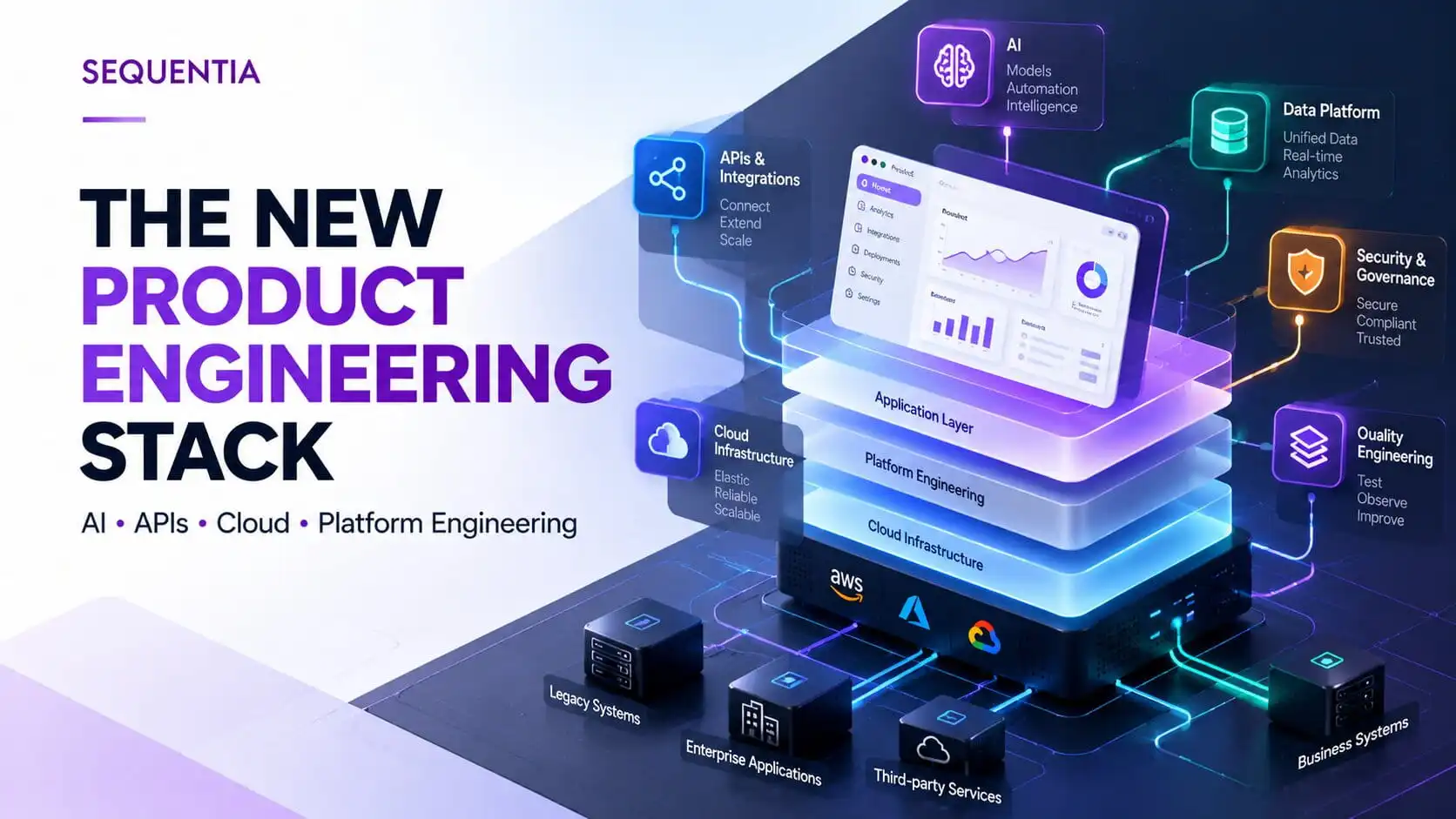
Data provides the context. APIs connect systems. Application services manage workflows. AI capabilities process or generate information. Infrastructure provides the runtime environment. Security controls access. Quality engineering validates behavior. Observability provides operational visibility.
The quality of the overall solution depends on how these layers work together.
Data becomes part of the AI architecture
AI systems are only as useful as the information they can access and interpret.
Enterprise environments rarely have information sitting neatly in one place. Data may exist across databases, ERP systems, CRM platforms, documents, APIs, internal applications and third-party services.
Making that information usable by AI therefore becomes an architectural problem.
Questions around data quality, freshness, accessibility, permissions and transformation need to be addressed before the system can consistently deliver useful outcomes.
For retrieval-based AI applications, this becomes even more important. Document processing, indexing, retrieval, access control and source management can all influence the quality of the final response.
The model is processing the context it receives. The engineering architecture determines much of that context.
APIs become the connective layer
Enterprise AI rarely operates in isolation.
An AI capability may need customer information from one system, transaction data from another, product information from a third and business rules from an existing application.
This is where API architecture becomes critical.
Well-designed APIs can allow AI capabilities to interact with existing applications without tightly coupling the entire technology environment to a particular model or implementation.
This becomes particularly valuable when organizations have a combination of legacy applications, modern cloud services, mobile applications, web platforms and third-party systems.
AI can then become another capability within the enterprise technology ecosystem rather than a disconnected application.
Business logic should remain deterministic where it needs to be
One of the most important architectural decisions is determining what the AI should control and what it should not.
AI can be extremely effective at interpreting unstructured information, summarizing content, extracting information, generating responses and supporting decisions.
That does not mean every business rule should be delegated to a model.
Critical calculations, authorization decisions, transaction rules and other deterministic processes may need conventional application logic.
A mature AI architecture separates these responsibilities.
The AI handles the tasks where probabilistic intelligence creates value. The application continues to enforce the rules that need predictable behavior.
This distinction becomes particularly important as AI systems become more autonomous.
Production AI requires quality engineering
Traditional software testing remains essential, but AI introduces additional dimensions of quality.
A response can be technically valid but incomplete. It can be well written but factually incorrect. It can be relevant in one situation and inappropriate in another.
That means AI applications need evaluation strategies designed around the actual business use case.
Teams need to establish what constitutes an acceptable response and how that quality will be measured.
Depending on the application, this may involve evaluating accuracy, relevance, groundedness, consistency, response time, safety and adherence to business rules.
Quality engineering therefore moves beyond checking whether the application works.
It becomes part of determining whether the AI system is behaving appropriately.
Infrastructure becomes part of the business equation
An AI application that works well with a small number of users may behave very differently under enterprise workloads.
Latency, concurrency, availability and cost all become important.
Architecture decisions around caching, asynchronous processing, compute resources, model selection and workload management can significantly influence the economics of the application.
There may also be multiple infrastructure dependencies involved in delivering a single AI workflow.
This makes infrastructure management an important part of AI engineering.
Scaling an AI application isn't simply about supporting more users. It is about supporting those users while maintaining acceptable performance, reliability and operating economics.
Security cannot be added after the architecture is finished
Enterprise AI applications can interact with sensitive information, internal systems and business-critical workflows.
Security therefore needs to be considered across the entire architecture.
Authentication and authorization should be enforced at the application and infrastructure layers. Data access needs to respect existing permissions. Sensitive information needs appropriate protection. External AI services need to be evaluated according to the organization's security requirements.
AI-specific risks also need consideration.
Prompt injection, inappropriate data exposure, uncontrolled tool access and unexpected model behavior can introduce new attack surfaces.
A production AI architecture needs to account for these risks rather than treating AI security as a separate exercise after development.
Observability completes the engineering layer
Once an AI application is in production, engineering teams need visibility into more than uptime.
They need to understand response quality, model usage, latency, failures, costs and the behavior of different workflows.
This makes observability particularly important.
Traditional application monitoring can tell a team that a service is unavailable. AI-specific monitoring can help identify that a service is technically available but producing poor results for a particular class of requests.
Both perspectives are necessary.
The objective is to understand the health of the complete system, not just the health of the model.
Enterprise AI requires architecture that can evolve
AI technology is changing rapidly.
Models are improving, pricing structures are changing and new capabilities are appearing continuously. Organizations therefore need architectures that can evolve without requiring a complete rebuild every time the underlying technology changes.
Modularity becomes important.
The application should ideally be able to change a model provider, retrieval strategy or supporting service without forcing a redesign of the entire product.
This is one reason enterprise AI should be approached through sound engineering principles rather than through individual technology choices.
The technology will change.
The architecture needs to accommodate that change.
Building AI into the enterprise
The next phase of enterprise AI will be less about demonstrating what a model can do and more about integrating intelligent capabilities into products, processes and existing technology environments.
That requires a broader engineering perspective.
Data, APIs, application architecture, security, quality engineering, infrastructure and observability all become part of the AI conversation.
The organizations that approach AI this way can make intelligent capabilities part of their existing technology landscape instead of creating isolated experiments that are difficult to scale.
AI may be the visible intelligence in the application. The engineering architecture is what makes that intelligence usable, reliable and scalable.

.webp)
Pune
Sequentia Software Solutions Pvt Ltd
401, Koyna, Mohan Nagar,
Baner, Pune, Maharashtra - 411045.
Jalgaon
Sequentia Software Solutions Pvt Ltd
06, Rambhau Joshi Market, Opposite Golani Market, Navi Peth, Jalgaon, Maharashtra - 425001.