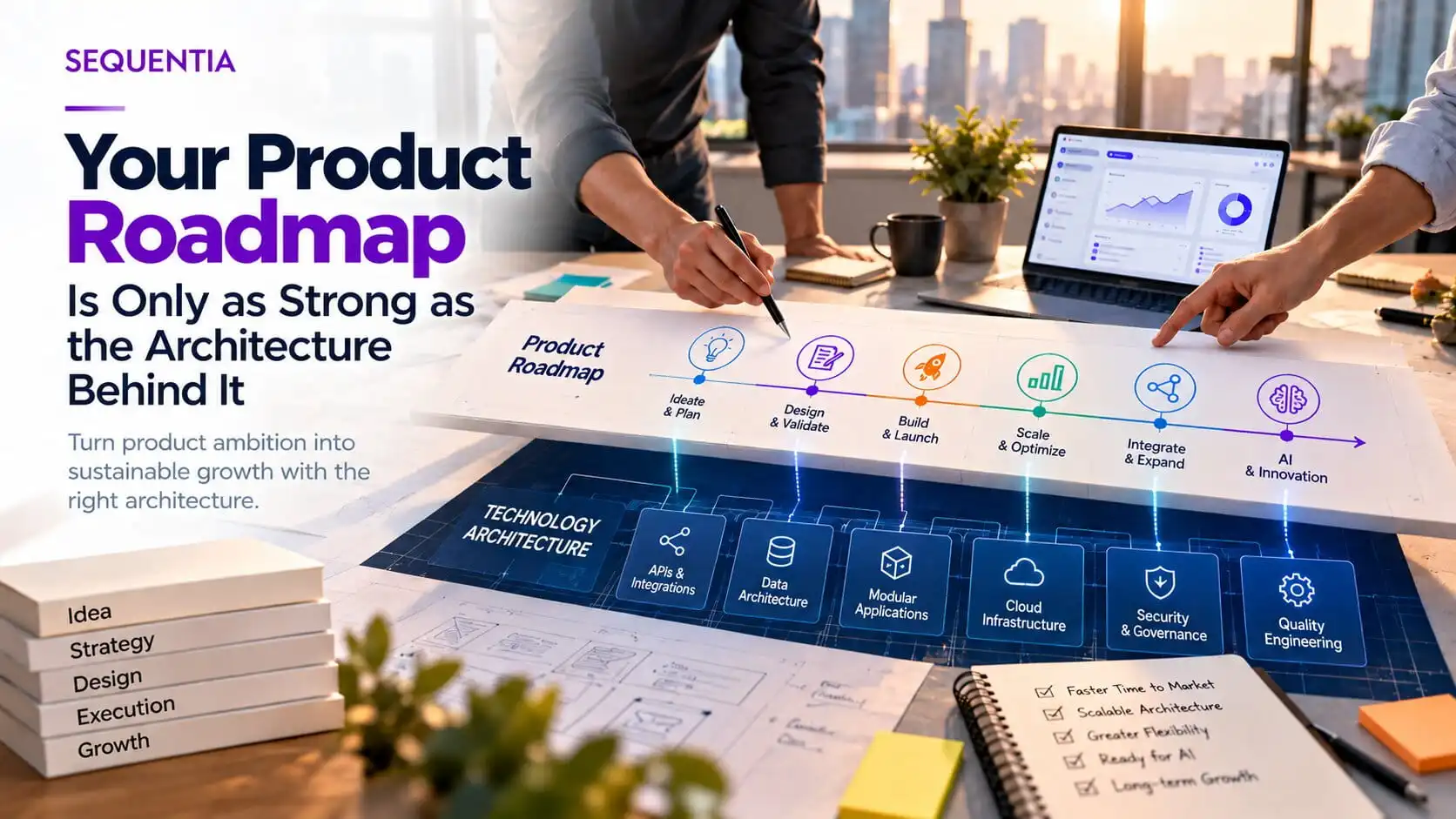
Your Product Roadmap Is Only as Strong as the Architecture Behind It
A product roadmap represents business ambition.
It captures where an organization wants its product to go, which customers it wants to serve, what capabilities it wants to introduce and how the product should evolve over time.
But every roadmap eventually meets a less visible constraint: technology architecture.
A product can have an excellent market opportunity, a strong product strategy and a well-prioritized roadmap. If the underlying architecture cannot absorb that roadmap efficiently, execution becomes progressively harder.
This is why product strategy and technology architecture cannot be treated as completely separate disciplines.
The architecture behind a product needs to evolve at the same pace as the product itself.
When Product Ambition Outgrows Architecture
Early in a product's lifecycle, speed often matters more than architectural perfection.
Teams need to validate ideas, respond to customers and establish the product in the market.
Over time, however, successful products accumulate complexity.
More users arrive. More features are introduced. More integrations are required. New business rules emerge. Data becomes more valuable. Different teams begin working on different parts of the platform.
An architecture that was appropriate for the first stage of the product may no longer be appropriate for the next stage.
This is not necessarily technical failure.
It is often a natural consequence of product growth.
The challenge begins when the architecture is allowed to remain unchanged while the product roadmap becomes significantly more ambitious.
The Hidden Cost of Feature-Driven Architecture
A roadmap is usually organized around business capabilities.
The architecture, however, needs to consider relationships between those capabilities.
Adding one feature may look straightforward until the engineering team discovers that it touches authentication, data models, APIs, application services and several existing workflows.
When this happens repeatedly, feature development becomes slower and less predictable.
Engineering teams spend more time navigating dependencies and less time creating new product capabilities.
This is one reason architectural thinking needs to be part of product planning.
The question should not only be:
What are we building next?
It should also be:
What will this decision require the product architecture to support six, twelve or twenty-four months from now?
Product Strategy and Technology Strategy Need to Work Together
This is where Product Strategy & Consulting becomes closely connected with Product Tech Advisory.
Product strategy defines business direction, customer priorities and product outcomes.
Technology strategy translates those ambitions into an engineering environment capable of supporting them.
If these conversations happen independently, technology decisions can become reactive.
A product team may commit to a capability without understanding the architectural implications. Engineering teams may then have to introduce workarounds to meet the roadmap.
Over time, those workarounds can become additional architecture debt.
A stronger approach brings product and technology decisions together early enough to influence each other.
The goal isn't to slow down product planning with technical discussions.
It is to make product planning more realistic and technology investment more intentional.
Architecture Should Create Product Options
A strong product architecture does more than support today's requirements.
It creates options for tomorrow.
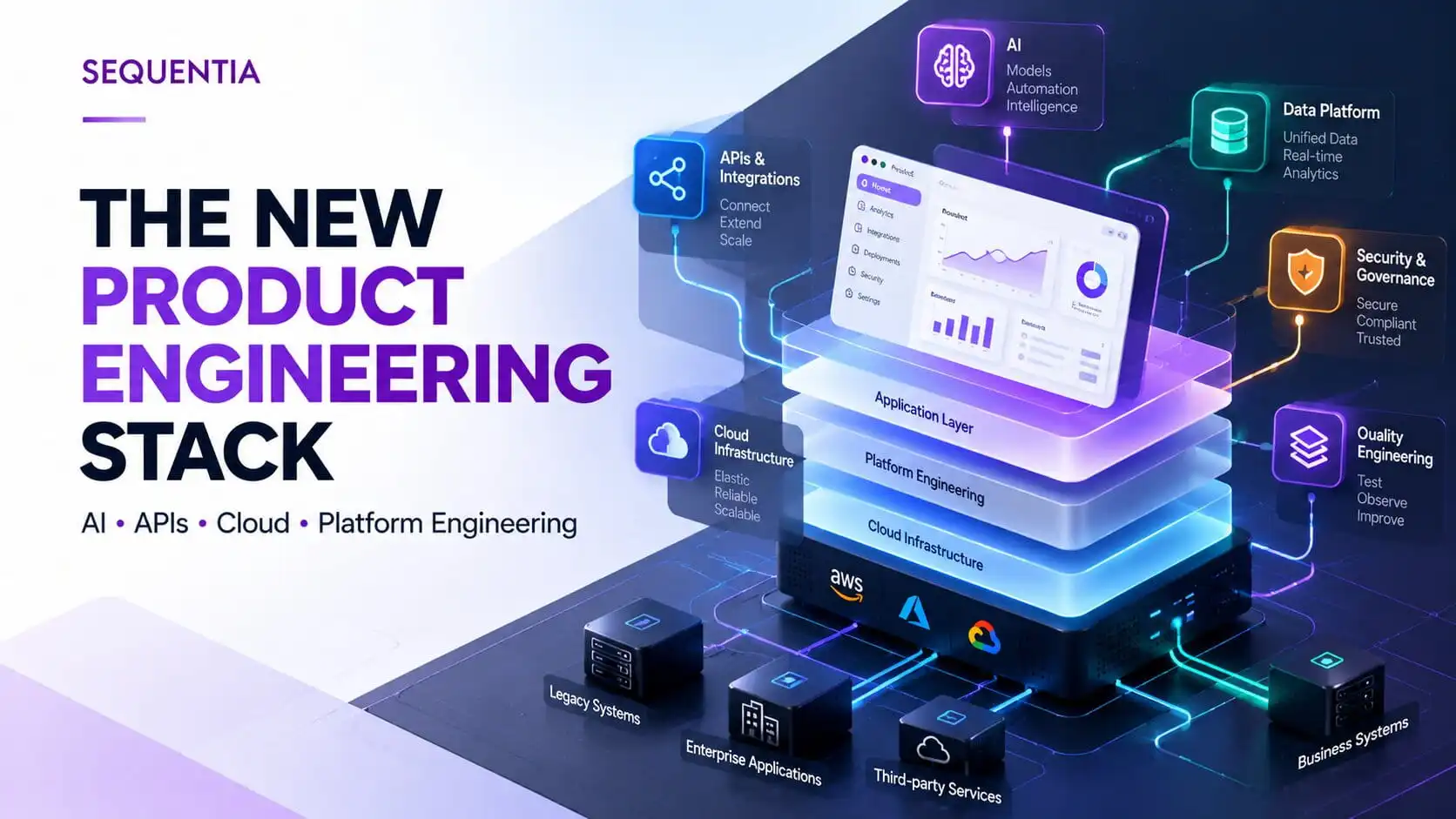
A modular architecture can make it easier to introduce new capabilities without changing unrelated components.
Well-designed APIs can allow products to integrate with new systems without creating tightly coupled dependencies.
Decoupled services can allow individual capabilities to evolve independently.
A scalable infrastructure strategy can accommodate changing workloads.
Strong quality engineering can provide confidence when multiple parts of the product are changing simultaneously.
These are not purely technical improvements.
They influence how quickly a business can respond to new opportunities.
The Role of Product Design & Engineering
Product architecture should also be considered alongside the actual user experience.
Through Product Design & Engineering, product decisions, user journeys and technology architecture can be considered together rather than as separate stages.
A new customer journey may require new services.
A new workflow may require different data relationships.
A new digital experience may require APIs that do not currently exist.
A new AI capability may require access to information that was previously isolated.
When design and engineering operate closely together, these dependencies can be identified earlier.
That creates a more realistic path from product concept to production.
AI Is Adding Another Dimension
AI is making architectural flexibility even more important.
Modern products increasingly want to introduce intelligent search, recommendations, document processing, conversational interfaces, workflow automation and decision-support capabilities.
These capabilities often depend on existing product data and business systems.
The AI component may be relatively easy to introduce.
Connecting it safely and reliably to the rest of the product can be much harder.
This is where APIs, application architecture, data accessibility, security and infrastructure become important.
A product that has been designed to evolve can incorporate new AI capabilities more easily than one where critical functionality is tightly coupled across legacy components.
AI therefore isn't only creating new product opportunities.
It is also exposing architectural limitations that may have remained hidden.
Modernization Should Follow Product Direction
When architecture becomes a constraint, the answer isn't automatically a complete rewrite.
For many established products, replacing everything at once introduces significant technical and business risk.
Application Transformation provides another path.
Organizations can identify the components creating the greatest constraint and modernize them progressively.
This might involve introducing APIs around established applications, separating services, modernizing selected components, improving infrastructure or redesigning specific parts of the application architecture.
The product continues operating while the technology foundation evolves.
This approach connects modernization investment directly to product priorities.
Instead of asking:
How do we modernize everything?
the more useful question becomes:
Which architectural changes will give the product the greatest ability to evolve?
Architecture Needs to Evolve With the Roadmap
A product roadmap should not be considered a fixed list of features that engineering simply implements.
It is a view of where the product is expected to go.
Architecture should be treated in a similar way.
As product priorities change, architectural priorities should change with them.
A roadmap focused on international expansion may require different architectural decisions from one focused on AI-powered workflows.
A roadmap focused on high transaction volumes may require different infrastructure decisions from one focused on complex enterprise integrations.
There is no single perfect product architecture.
There is only architecture that is appropriate for the product's current direction and capable of evolving toward its future direction.
Building Room for the Next Product
The strongest product engineering environments don't eliminate change.
They make change easier to absorb.
That requires deliberate decisions around architecture, APIs, data, infrastructure, security and quality engineering.
It also requires product and technology leaders to have a shared understanding of where the product is going and what the technology foundation needs to support that direction.
This is why Product Strategy & Consulting, Product Tech Advisory, Product Design & Engineering and Application Transformation are closely connected capabilities.
Together, they help bridge the gap between product ambition and engineering reality.
A roadmap tells you where the product wants to go.
Architecture determines how effectively it can get there.
.webp)
Pune
Sequentia Software Solutions Pvt Ltd
401, Koyna, Mohan Nagar,
Baner, Pune, Maharashtra - 411045.
Jalgaon
Sequentia Software Solutions Pvt Ltd
06, Rambhau Joshi Market, Opposite Golani Market, Navi Peth, Jalgaon, Maharashtra - 425001.